A Mesmerising Journey to the Sublime Valley of Flowers
Being one of those rare natural botanical gardens in the country, a trek to this floral city is known for evoking an unfathomable elation in the mind of trekkers. When one of my friends, who is an ardent trekker, asked me to accompany her to the Valley of Flowers, I quickly signed up without any second thought. Next day, we began our journey at 4 am. Traveling via Dehradun brought back so many fond travel memories for me. We soon reached Haridwar, which is the starting point of the Valley of Flowers trek.
The journey started with a trail from Haridwar to Govindghat. We reached Govindghat via Rishikesh, Devprayag, Srinagar, Rudraprayag, and Karanprayag. However, one can also reach the place via the winter abode of Lord Badrinath and Joshimath. Along the way, do not miss an opportunity to witness the holy confluence of Bhagirathi and Alaknanda Rivers that together form the River Ganges. Though it’s a long journey, the path is fascinating when one notices the stunning convergence of these two rivers. It is likely that you may get tired, therefore, it is advised to take a short break and relax in a gorgeous apple orchard on the way.
After some rest, it was time for us to move from the base camp Govindghat to Ghangaria. The first day of Valley Of Flowers trek began with a 14 km gradual ascent from Govindghat to Ghangaria. The beauty of a number of waterfalls and lush greenery hypnotized us. In addition, the villagers told us that the world’s highest Gurudwara and the most revered of all Sikh Shrines, the ‘Hemkund Sahib’, is situated nearby, at an altitude of 4,329 meters. Ghangaria is a base camp for the Valley Of Flowers trek, and people can avail different services that include hiring a mule or using a helicopter. We had booked rooms at Garhwal Mandal Vikas Nigam, which is considered as the best place to stay in Ghangaria.
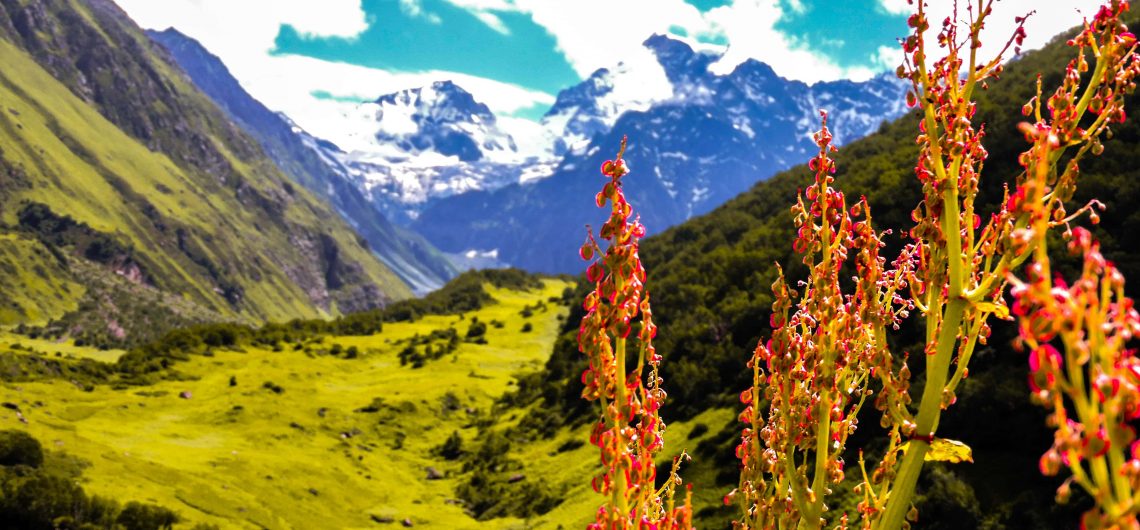
Next day after having some scrumptious Aloo Paranthas, we started a trek through Ghangaria to Valley of Flowers. The most difficult thing during the trek was to face heavy winds, but it was heartening to see that trekkers were helping each other to move ahead comfortably. As we scaled a height of 3,858 m to arrive at the Valley of Flowers, we witnessed thousands of flowers in full bloom. Our eyes were glazed by a fantastic and beautiful sight. At the starting point of this national park, I came across the Balsam flowers that sported bright light pink, blue and orange colors, followed by Himalayan Slender Tape Vine, Meadow Rue, Dwarf Globe Flower, and Marsh Marigold. The majesty of ‘Brahma Kamal’ (Saussurea obvallata) too was evident among the cluster of white and black Daisy flowers. It took around four hours to admire the rare and exotic beauty of the flowers spread like a blanket sheet, stretched over an expanse of 87.50 km. A unique blend of snow-capped mountains, green meadows, and white clouds made our trek a dreamlike adventure.
As we had hired a guide to know better about the place, he told us that the credit to discover the valley goes to two British people i.e. mountaineer Frank Smith and botanist Joan Margaret Legge, who explored the valley together in the 1930s. However, botanist Prakash Chandra Kala from the Wildlife Institute of India spent a decade in the valley. During that period, he compiled two books known for having an inventory of all the flowers that blossom here, with their common and scientific names.
The floral site is a feast for the eyes and lends a unique experience in itself. The trail will become steeper, however, the finest creations of nature will keep you inspired and enchanted. When the much-awaited destination is right in front of you, it seems that every ounce of energy lost in the trail did not go in vain. Most of the people experience mixed emotions where excitement and relief come together to celebrate the joy of achieving something that you have aimed for. You should spend some peaceful time in the lap of nature and capture some scenic images in your heart. Notably, it is a tea house trek because there are a number of tea-houses that bring you the finest qualities of fragrant teas. The best time to visit the valley is from July to September, as flowers are in full bloom at that time. However, don’t forget to carry your rain gear, because it is the monsoon season after all, and it keeps raining here. Importantly, shoes play a major role during a trek, so one should avoid wet shoes and opt for shoes with water resistance.